

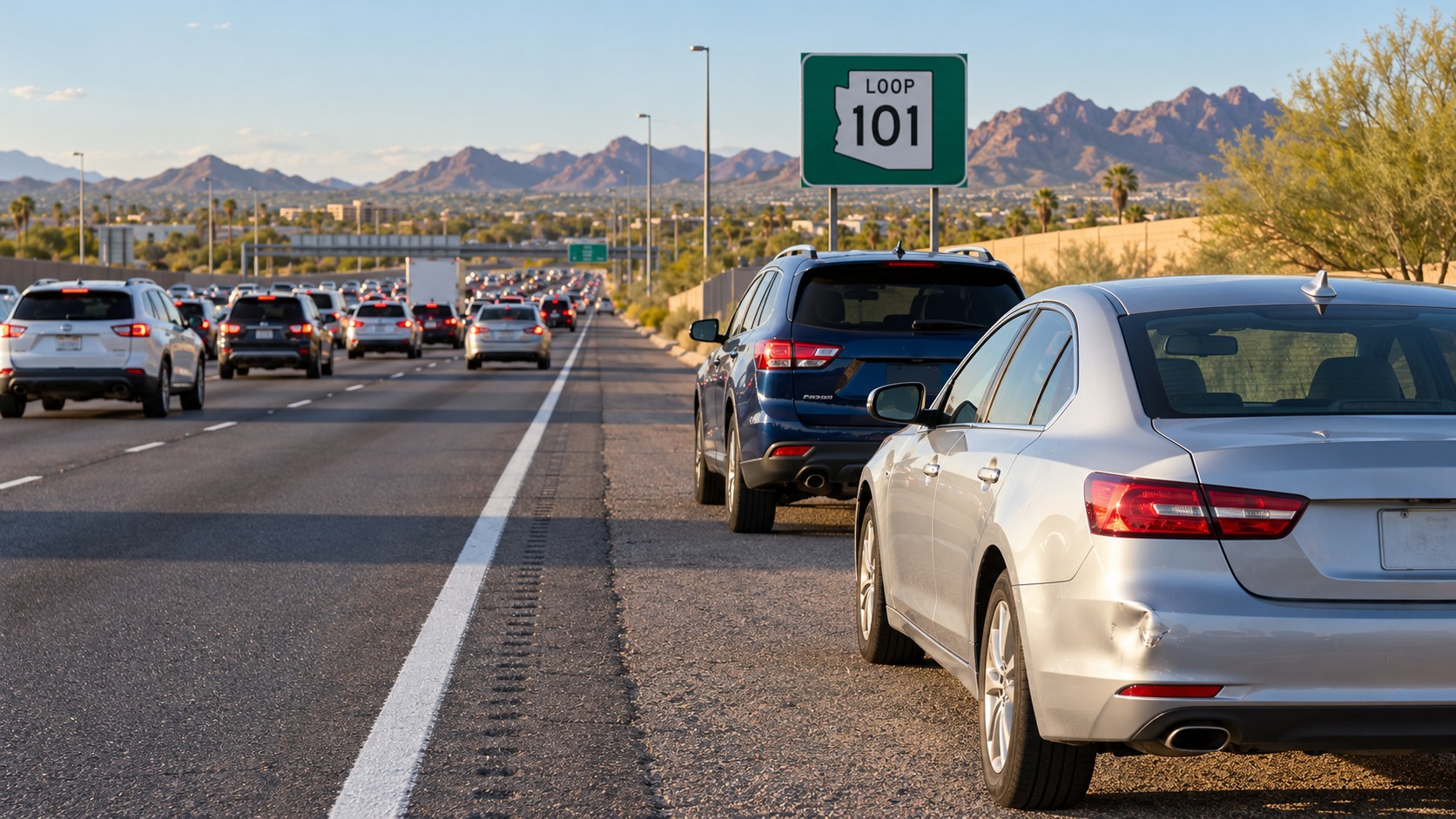
Rush Hour, Brake Lights, and a Fender Bender: What to Do After a Crash on Loop 101
Practical next steps for Arizona drivers when stop-and-go traffic turns into an accident.
Move a few feet. Tap the brakes. Stop again.
If you regularly drive Loop 101 through Scottsdale or Tempe, you know the rhythm. One moment traffic starts moving, and the next you’re staring at a wall of brake lights.
Then comes the impact.
Even a seemingly minor collision can feel overwhelming when vehicles are passing nearby, another driver is approaching, and you’re trying to figure out what to do first.
Before worrying about the bumper, insurance paperwork, or how late you’ll be, focus on the immediate situation: checking on people, getting help, and avoiding another collision.
Check on People Before Checking the Damage
First, check yourself and your passengers. Call 911 if someone is injured, you suspect an injury, or the crash creates an immediate danger.
Tell the dispatcher you are on Loop 101, your direction of travel, and the nearest exit, cross street, or mile marker you can identify. Explain whether vehicles are blocking lanes and whether anyone needs assistance.
Follow the dispatcher’s instructions. A serious crash, an injured occupant, or a vehicle that cannot move safely requires a different response from a minor fender bender.
Arizona’s driver manual emphasizes checking occupants first, calling for help, and staying out of travel lanes. apps.azdot.gov
A Minor Crash Does Not Mean You Should Stay in the Traffic Lane
One common misconception is that vehicles must remain exactly where they collided until someone photographs the scene or an officer arrives.
For a minor, non-injury crash, Arizona’s Quick Clearance guidance says to move operable vehicles out of travel lanes as soon as it is safe.
Arizona DPS recommends getting completely off the highway to a nearby parking lot, side street, or gas station when the vehicles can be driven safely. If that is not possible, a shoulder or other emergency refuge may provide temporary space away from traffic.
Moving to a nearby safer location does not mean leaving the incident. You still need to exchange information and meet your responsibilities after the crash. Department of Public Safety
Do not force a damaged vehicle to move or attempt a risky maneuver simply to clear a lane. If you cannot move safely, tell the dispatcher where you are and follow instructions.
Your Photos Can Wait Until You Are Out of Danger
After a collision, it is natural to reach for your phone. You want proof of what happened and a record of the damage.
But standing between vehicles or walking around a car in an active freeway lane creates another problem.
DPS recommends exchanging information and taking photographs after moving to a safer location. Quickly clearing minor incidents helps reduce the risk of secondary collisions involving approaching traffic. Department of Public Safety
Once conditions allow, useful information to collect includes:
- The other driver’s name, contact information, driver license details, insurance information, and license plate.
- Photos of the vehicles and visible damage, taken from a safe position.
- The time, location, direction of travel, and your factual account of what happened.
- Witness contact information, if available.
- The responding agency and report or incident number, if one is provided.
Arizona’s driver manual identifies driver, insurance, vehicle, and witness information as important details to exchange. apps.azdot.gov
“It Still Drives” Is Not a Complete Damage Assessment
Getting a vehicle out of traffic is one decision. Deciding whether to continue your commute is another.
If the vehicle has leaking fluids, loose components, tire interference, warning lights, or changes in steering or braking, describe those concerns to responding personnel or a towing professional. Do not continue driving simply because the engine starts.
Likewise, a bumper that looks only slightly damaged does not tell you everything about the vehicle’s condition.
A professional collision repair evaluation can help establish what needs further inspection and what repairs may be necessary. The roadside is not the place to decide that a vehicle only needs paint.
Start the Repair Conversation With Clear Information
Once the immediate situation is under control, contact your insurer to discuss reporting the loss and the applicable claim process.
Keep your photos, incident information, and claim details together. When you speak with a repair shop, describe the collision and any changes you noticed afterward. Explain whether the vehicle was towed or driven from the scene.
Orlando Auto Body provides collision repair services and insurance claim assistance. The team can help you understand the repair process and the information needed to get started.
Coverage, deductibles, and payment decisions depend on your policy and the circumstances of the claim.
Give Yourself More Room in Stop-and-Go Traffic
The best time to think about a rush-hour collision is before one happens.
Watch beyond the vehicle directly ahead when visibility allows. Leave space to respond to changing traffic, avoid distractions, and resist the temptation to treat every opening as a chance to gain one car length.
Arizona’s driver manual recommends maintaining a space cushion and allowing additional room when another driver follows too closely, giving you more opportunity to slow gradually. apps.azdot.gov
Your destination will still be there. An extra few feet of space can give you more time to react.
After the Freeway, Take the Next Step With Orlando Auto Body
A collision can interrupt your commute in seconds. Getting the vehicle repaired takes a clearer plan.
Once everyone is safe and the roadside situation has been addressed, Orlando Auto Body can help you move into the evaluation and repair process.
Start your online check-in and share the details of your vehicle and collision. From a rush-hour fender bender to more extensive damage, the next step starts with understanding what your vehicle needs.
Frequently Asked Questions
Should I move my car after a minor accident on Loop 101?
For a minor crash without injuries, Arizona’s Quick Clearance guidance calls for moving an operable vehicle out of travel lanes when it can be done safely. DPS recommends a nearby location off the highway when possible. If someone is injured or you are uncertain whether moving is safe, call 911 and follow instructions.
Should I photograph the vehicles before moving them?
Do not remain in an active traffic lane or step into traffic to take photographs. For a minor, non-injury crash involving safely operable vehicles, prioritize moving out of travel lanes. Document the damage once you have reached a safer location.
Can I drive my car if the bumper is damaged?
That depends on the vehicle’s condition. Visible damage alone cannot establish whether it is safe to continue driving. Report leaking fluids, loose parts, warning lights, or changes in steering or braking, and arrange professional assistance when safety is uncertain.
Can Orlando Auto Body help with the insurance repair process?
Yes. Orlando Auto Body offers collision repair and insurance claim assistance. Bring the claim information you have, along with photos and incident details, so the team can explain the next steps for your vehicle.