

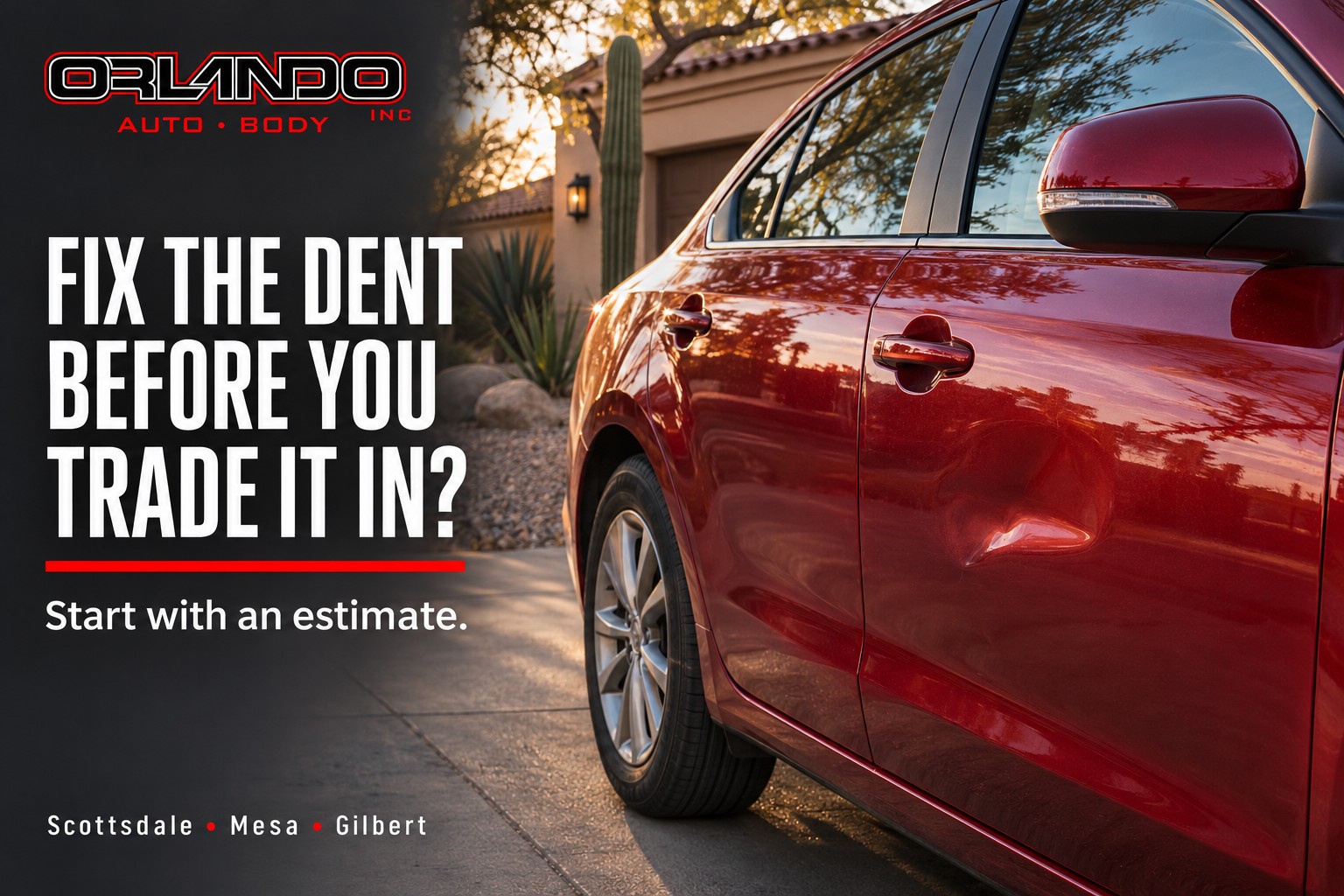
Before you spend money fixing every scratch, find out which repairs make sense for your next move.
You’ve stopped noticing that dent in the passenger door. The person appraising your trade-in probably won’t.
Maybe it happened in a grocery store parking lot. Maybe your teenager introduced the bumper to the garage. Or maybe you bought the vehicle with that little crease and have been meaning to deal with it ever since.
Now you’re thinking about trading it in, and suddenly the damage looks a little more noticeable.
Should you fix it first? Leave it alone? Try one of those dent-removal kits you keep seeing online?
The right answer starts with understanding the damage and getting an estimate. Some repairs may be worth considering before a sale or trade-in. Others may cost more than you’re likely to recover.
At Orlando Auto Body, we help drivers in Scottsdale, Mesa, and Gilbert understand their repair options so they can make that decision with better information.
You’ve Gotten Used to It. A Buyer Hasn’t.
When you live with a vehicle every day, its imperfections become familiar. You know the scratch beside the door handle doesn’t bother you. You’ve learned to look past the bumper scrape.
Someone evaluating the vehicle is seeing those details for the first time.
Vehicle condition plays a role in its value. Kelley Blue Book explains that trade-in values account for condition and that dealers have to consider reconditioning and other costs before reselling a vehicle. That doesn’t mean every dent deserves an expensive repair, but it does mean visible damage belongs in the conversation. My Car’s Value
Start by washing the vehicle and looking at it in good daylight. Walk around both sides instead of checking only the driver’s door. You may find that the damage you’ve been worrying about is minor, while something you rarely see deserves a closer look.
Our article about small scratch and dent repair explores why those everyday imperfections are worth having assessed.
Not Every Dent Needs the Same Repair
A shallow door ding with intact paint is a different problem from a sharp crease with cracked paint. A bumper scuff is different from a bumper cover that is loose or split.
Depending on the dent’s location, depth, accessibility, and paint condition, paintless dent repair may be an option. This technique reshapes suitable damage while preserving the existing paint finish.
Other damage may require conventional body repair and refinishing. The important step is finding out which approach fits your vehicle before assuming the repair will be either inexpensive or out of reach.
If you’re curious about the process, our guide to why shops use paintless dent repair explains how it differs from repairs involving filler and paint.
Get the Numbers Before Making the Decision
A repair estimate and a trade-in appraisal answer two different questions.
The body shop can explain what the damage requires and what the proposed repair will cost. The dealer or buyer determines what they’re willing to offer for the vehicle.
Before authorizing cosmetic work solely to improve a trade-in offer, ask the appraiser how the existing damage affects their offer and whether repairing it would change the amount. Then compare that information with the repair estimate.
For example, imagine a purely hypothetical repair costing $700. If a dealer indicates that completing it would increase the offer by only $300, the repair would not pay for itself through that trade-in. A different vehicle, repair, or selling arrangement could produce a different result.
There is no universal dollar amount that makes a dent “worth fixing.” The decision depends on your vehicle, the repair, and the offer you actually receive.
Also ask what the estimate includes. When damage came from an impact, the initial assessment may not reveal everything behind a panel. Our explanation of why collision repair estimates can change can help you understand that distinction.
Trading In, Selling Privately, or Keeping It?
Your next step with the vehicle changes the way you should think about repairs.
If you’re trading it in soon, the practical question is whether the expected change in the offer justifies the repair cost and time involved. You may decide to trade it in with the damage after discussing it openly with the dealer.
If you’re selling privately, think about how you’ll present the vehicle and explain its condition. Keep repair records and photographs when available. A repaired panel does not erase an accident history, and making the vehicle look better should never mean concealing what happened.
If you’ve decided to keep driving it, the benefit is different. You may simply want to enjoy your vehicle again, address damaged paint, or have an old impact properly evaluated. You don’t have to justify every repair through a future resale price.
Arizona Paint Damage Deserves Its Own Conversation
Sometimes the problem isn’t a dent at all. It’s the hood that has gone chalky or the roof where the clear coat is peeling.
That calls for a different assessment than a parking lot ding. Once the clear coat has failed, washing and waxing cannot replace the missing finish. Professional preparation and refinishing may be needed to address the affected area.
Our guide to why car paint peels in Arizona explains how sunlight and heat contribute to the problem.
Before repainting a panel strictly for a trade-in, follow the same approach: understand the repair, get the estimate, and compare it with your plans for the vehicle.
Don’t Let a Trade-In Deadline Turn Into a Shortcut
It can be tempting to make damage less noticeable just long enough to get through an appraisal. But a quick cover-up doesn’t tell you whether the underlying problem has been addressed.
That matters especially when the damage came from a collision. A mark on the bumper may be cosmetic, or the impact may have affected components behind it. The vehicle needs an assessment before anyone can make that distinction confidently.
Our article about what happens during a collision repair inspection explains how technicians look beyond the visible damage.
If you’ve noticed loose panels, lights that no longer fit correctly, or warning messages since an impact, mention those concerns when arranging the inspection. They deserve attention regardless of when you plan to sell.
Before You Say Goodbye to the Car, Get to Know the Damage
You don’t need to restore every used vehicle to showroom condition before moving on. You do need enough information to make a sensible choice.
Bring Orlando Auto Body the dent you’ve been walking past, the bumper scrape you’ve been ignoring, or the paint damage you’re unsure about. Tell us whether you’re planning to trade in, sell privately, or keep the vehicle so we understand your goal when discussing the repair options.
Visit our Scottsdale, Mesa, and Gilbert locations page to connect with the shop that works best for you.
The dent may have been easy to ignore. Getting answers doesn’t have to be.
Frequently Asked Questions
Should I repair every dent before trading in my car?
No. Start with a repair estimate and an appraisal that accounts for the vehicle’s current condition. Ask whether completing the proposed repair would change the offer. Cosmetic repairs may make sense in some situations, but they do not guarantee a higher offer or a full return on what you spend.
Can paintless dent repair fix a door ding before I sell my vehicle?
It may be an option when the paint is intact and the dent’s shape, location, and accessibility are suitable. A technician needs to inspect the damage to determine whether paintless dent repair or conventional body repair is appropriate.
Will repairing body damage remove my vehicle’s accident history?
No. Completing repairs does not erase the history of an accident. Keep documentation of the work and describe the vehicle’s condition accurately when discussing it with a buyer or dealer.
What if I’m not sure whether the damage is only cosmetic?
Arrange an inspection, particularly if the damage followed an impact. Explain how it happened and mention any changes you’ve noticed since, such as loose trim, uneven panel gaps, or warning messages. The inspection helps establish what needs attention before you decide how to proceed.