

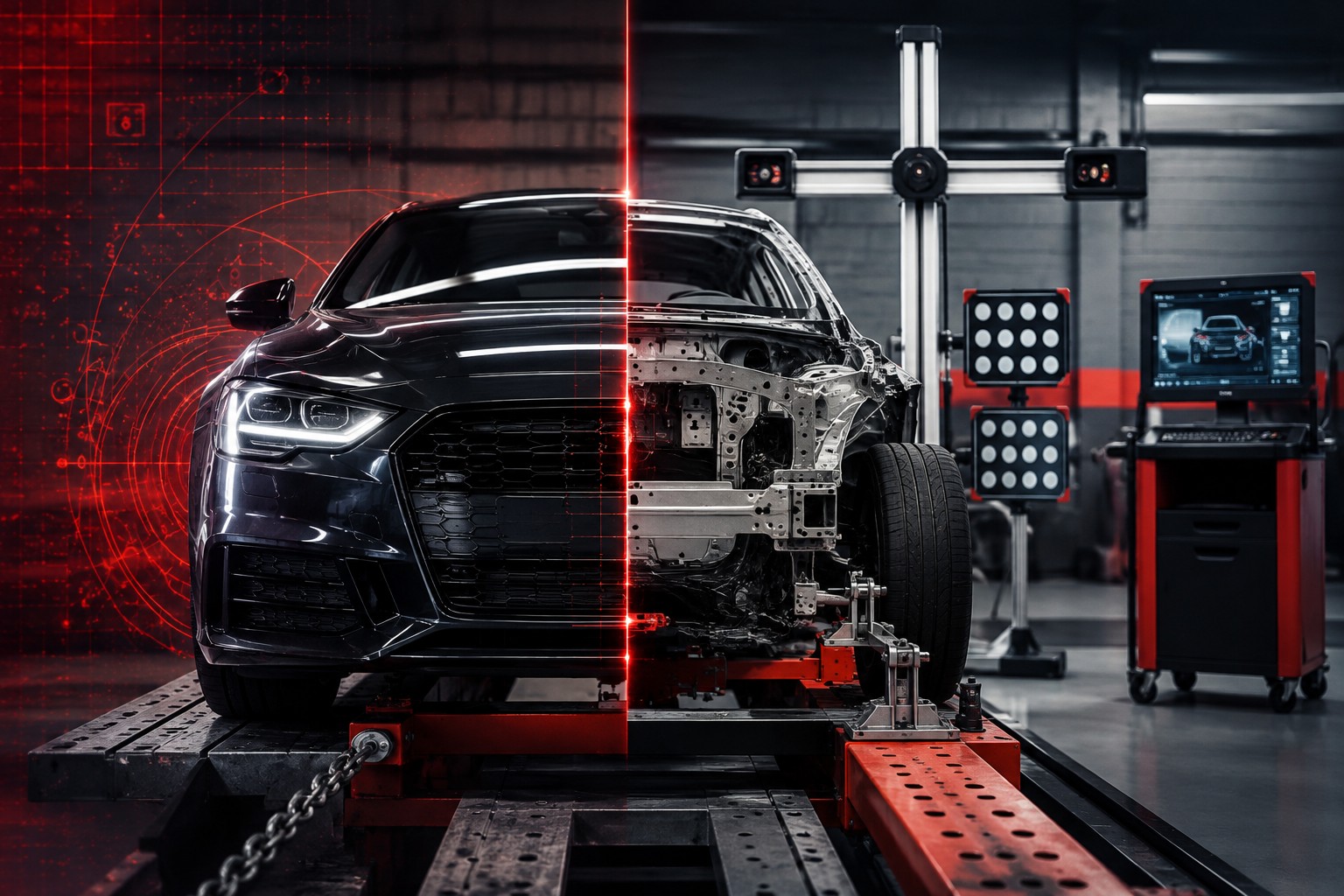
Your Car Has Cameras, Radar and Sensors. Who Makes Sure They Still Know Where They’re Looking?
A Behind the Scenes Look at the Technology Used in Modern Collision Repair
You get your vehicle back after an accident.
The body panels line up.
The paint looks beautiful.
The steering wheel is straight.
Everything looks like it did before.
But modern vehicles have something older cars did not.
They are constantly watching the road.
Cameras may be looking through the windshield. Radar sensors may be hidden behind bumpers. Other sensors may be monitoring the areas beside and behind your vehicle.
They can support features such as lane departure warnings, adaptive cruise control, automatic emergency braking, blind spot monitoring and around view cameras.
Which raises an important question after collision repair:
Does your car still know exactly where it is looking?
That is one reason modern collision repair has become far more sophisticated than simply replacing damaged panels and matching paint.
At Orlando Auto Body, equipment from companies such as Spanesi and Autel helps our technicians address two very different parts of today’s vehicles.
The structure you can touch.
And the technology you usually cannot see.
First, The Vehicle Has to Be Physically Right
Before worrying about cameras and radar, technicians have to understand what happened to the vehicle itself.
A collision can affect much more than the panel showing obvious damage.
Structural components may move. Suspension components can be affected. Alignment may change. Mounting points may no longer be where the vehicle manufacturer intended them to be.
This is where professional structural measuring and repair equipment becomes important.
Spanesi structural repair systems are designed to allow technicians to secure, measure and correct damaged vehicles with precision. Their electronic measuring technology can evaluate structural points, mechanical components, suspension components and wheel alignment, while documenting measurements throughout the repair process.
In plain English?
We don’t want to eyeball it. We want to measure it.
No, Frame Repair Is Not Just Hooking Up a Chain and Pulling
If your mental picture of frame straightening involves a giant chain and someone saying, “Give it another tug,” modern collision repair is going to surprise you.
Today’s structural repair is controlled and measurement driven.
The vehicle can be secured to specialized equipment while technicians evaluate where structural points are currently located compared with where they are supposed to be.
Corrections can then be made while measurements help guide the process.
Spanesi’s systems are designed around restoring three dimensional vehicle measurements, including length, width and height, to original specifications.
That matters because making a quarter panel look beautiful and restoring the structure beneath it are two completely different jobs.
Then Comes the Electronic Side of the Vehicle
Once upon a time, repairing collision damage was largely mechanical and cosmetic.
Cars have changed.
Today’s vehicle may contain an entire network of cameras, radar units, sensors, modules and computers working together while you drive.
These systems are commonly referred to as Advanced Driver Assistance Systems, or ADAS.
Depending on the vehicle, ADAS technology may support:
- Automatic emergency braking
- Lane departure warning
- Lane keeping assistance
- Adaptive cruise control
- Blind spot monitoring
- Forward collision warning
- Around view camera systems
These systems rely on accurate information about the vehicle and the world around it.
That means collision repair may involve more than repairing what was physically damaged.
When manufacturer procedures require it, certain cameras and sensors may also need to be calibrated.
Your Car Can Be Straight and Still Need Calibration
This is where things get interesting.
Imagine a forward facing camera that helps your vehicle interpret lane markings.
The camera does not need to be hanging from the windshield to deserve attention.
Depending on the vehicle and repair performed, manufacturer procedures may require technicians to verify or calibrate ADAS components so those systems have the correct reference points.
And alignment can matter too.
Autel specifically incorporates alignment checks into its ADAS workflow because vehicle alignment and thrust angle can affect calibration accuracy. Its systems can compare alignment measurements with manufacturer tolerances before technicians proceed with ADAS calibration.
So modern collision repair can become a sequence:
Repair the structure.
Verify the alignment.
Diagnose the electronic systems.
Perform required calibrations.
Verify the work.
Suddenly that shiny bumper is only one piece of a much bigger repair.
Why Would an Accident Affect a Sensor That Doesn’t Look Broken?
Because these systems depend on position and orientation, not simply whether a component is visibly damaged.
A sensor may still be physically intact while the repair procedure calls for calibration because something affecting its reference point has changed.
The exact requirements vary by vehicle.
That is an important distinction.
Not every accident automatically means every ADAS system needs calibration.
The vehicle manufacturer’s repair procedures determine what needs to happen for that particular vehicle and repair.
The goal is not to perform unnecessary procedures.
The goal is to know when they are required and have the equipment and knowledge to perform them correctly.
So What Is That Giant Autel Equipment Actually Doing?
If you have ever walked through a modern collision shop and seen a large frame with strange looking targets positioned around a vehicle, you might reasonably wonder what on earth is happening.
Those targets give certain vehicle cameras and sensors known reference points during calibration.
Depending on the Autel system and the vehicle being serviced, technicians may use optical cameras, positioning targets, calibration patterns and laser guided equipment to position everything accurately according to the required procedure. Autel systems support calibration workflows for cameras, radar, around view monitoring and other ADAS technologies.
So no.
They are not just pointing the camera straight and calling it good.
😂
There is a procedure behind it.
Measure Before. Verify After.
This may be one of the most important changes in modern collision repair.
Technology gives technicians more ways to document what happened during the repair.
Spanesi’s electronic measuring system can provide pre repair documentation showing structural damage and post repair documentation showing the vehicle’s measurements after structural work.
Autel’s systems can similarly create pre scan and post scan reports and document required calibration procedures.
That creates a much better question than:
“Does it look fixed?”
The better question is:
“How did you verify the repair?”
Why Orlando Auto Body Invests in Equipment Most Customers Will Never See
Here’s the funny thing about collision repair equipment.
Nobody picks up their beautifully repaired vehicle and says:
“Wow. That frame rack was incredible.”
You notice the things you can see.
The paint.
The body lines.
The repaired bumper.
The door that looks new again.
But some of the most important investments a collision repair facility makes are in equipment customers may never notice.
Structural measuring systems.
Frame straightening equipment.
Diagnostic scanners.
Wheel alignment technology.
ADAS calibration equipment.
Shane Orlando and the Orlando Auto Body team invest in technology such as Spanesi structural repair equipment and Autel ADAS equipment because today’s vehicles demand a different level of collision repair.
A beautiful finish matters.
But so does everything underneath it.
One Vehicle. Two Very Different Kinds of Precision.
This is probably the simplest way to think about it.
Spanesi helps us address the physical geometry of the vehicle.
Where are the structural points?
What moved?
What needs to be corrected?
Are the dimensions where they should be?
Autel helps us address the electronic systems that depend on accurate positioning and information.
What systems are on the vehicle?
Are there diagnostic faults?
Is the vehicle properly aligned for calibration?
Does the manufacturer require a calibration?
Was that calibration completed and documented?
Those are very different jobs.
But on a modern vehicle after an accident, they can be parts of the same repair.
Ask Your Collision Shop This Question
You do not need to become an expert in frame machines, diagnostic scanners or ADAS calibration equipment before choosing a collision repair facility.
But there is one very good question you can ask:
“How do you verify that my vehicle has been properly repaired?”
A quality collision repair facility should be able to explain its process.
Not just how the paint will look.
Not just when your vehicle will be finished.
But how technicians identify damage, follow manufacturer procedures, perform necessary measurements and calibrations, and verify the vehicle before returning it to you.
Modern Cars Need Modern Collision Repair
When you pick up your vehicle, you may never see the Spanesi equipment that helped technicians measure and restore its structure.
You may never see the Autel targets used to calibrate a camera or radar sensor.
You probably will not read every scan, measurement or calibration report generated during the repair.
And that’s okay.
You should not have to become a collision repair technician to know whether your vehicle was repaired correctly.
You simply need to choose a shop that understands everything your vehicle needs.
Including the things you cannot see.
At Orlando Auto Body, we combine experienced collision repair technicians with modern structural measuring, repair, diagnostic and calibration technology to help restore today’s increasingly sophisticated vehicles.
With locations in Scottsdale, Mesa and Gilbert, we’re here when an accident turns your very technologically advanced vehicle into a very technologically advanced problem.