

Your Car Looks Great. But How Do You Know It’s Actually Safe?
Most people judge a collision repair with their eyes.
Does the paint match?
Do the body panels line up?
Can you still see where the accident happened?
Those are all important questions, and they’re exactly what you’d expect to look for when you pick up your vehicle.
But today’s vehicles are much smarter than they were even ten years ago.
Behind that freshly painted bumper are cameras, radar sensors, wiring, computers, and safety systems that most drivers never think about. If those systems aren’t working the way the manufacturer intended, your vehicle may not be fully repaired, even if it looks perfect on the outside.
That’s why modern collision repair has changed so much.
At Orlando Auto Body, making your vehicle look great is only part of the job.
The real work starts long before the paint booth.
The First Thing We Do Isn’t Grab a Wrench
When your vehicle arrives at our shop, one of the first steps is connecting it to specialized diagnostic equipment for what’s called a pre-scan.
Most customers have never heard of a pre-scan, but it’s become one of the most important parts of repairing today’s vehicles.
Think of it like going to the doctor after an injury.
Your doctor doesn’t simply look at your arm and guess whether it’s broken. They take X-rays to see what’s happening beneath the surface.
We do something very similar.
A pre-scan allows us to communicate with your vehicle’s computers before any repairs begin. It tells us if safety systems have detected problems, if electronic modules aren’t communicating properly, or if hidden damage exists that can’t be seen by looking at the outside of the vehicle.
Sometimes the scan confirms exactly what we expected.
Other times it reveals issues that would have otherwise gone unnoticed.
That’s valuable information because we want to repair the entire vehicle, not just the visible damage.
There’s Often More Going On Behind the Bumper
A front-end collision might leave you with a cracked bumper and a broken grille.
What you don’t see is everything sitting behind them.
Many newer vehicles have radar sensors mounted behind the front bumper. Cameras near the windshield help monitor lane markings. Other sensors assist with adaptive cruise control, automatic emergency braking, and blind spot monitoring.
Those components don’t always break during an accident.
Sometimes they’re simply moved a fraction of an inch.
To the human eye, that’s impossible to notice.
To your vehicle’s safety systems, it can make all the difference.
That’s one reason collision repair has become so much more technical than it used to be.
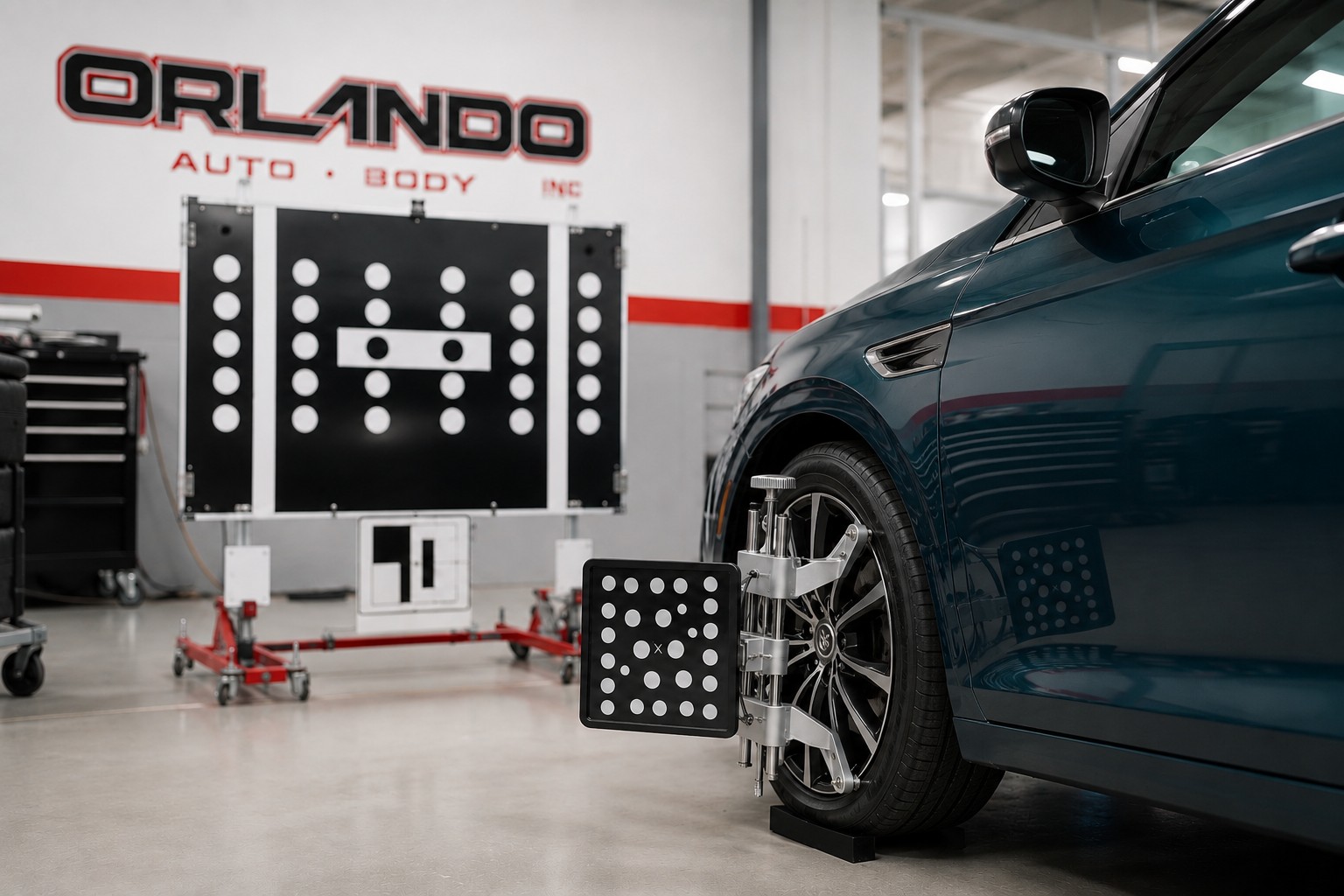
Why ADAS Calibration Matters
You’ve probably heard terms like Lane Keeping Assist, Adaptive Cruise Control, or Automatic Emergency Braking.
Those features all fall under a category called Advanced Driver Assistance Systems, or ADAS.
These systems rely on precise measurements to function properly.
If a radar sensor or camera is even slightly out of position after a collision, it may not interpret the road exactly the way it was designed to.
That doesn’t necessarily mean you’ll see a warning light on your dashboard.
In many cases, the system appears to be working normally.
That’s why calibration is so important.
It’s not about clearing codes or resetting electronics.
It’s about making sure the technology that’s designed to help protect you is seeing the road accurately again.
Every Repair Deserves One Final Check
Once repairs are complete, we don’t simply hand you the keys and hope everything is working correctly.
Your vehicle goes through another diagnostic process called a post-scan.
Think of it as the final exam.
The post-scan allows us to verify that the repair process was successful, the vehicle’s systems are communicating properly, and any required calibrations have been completed.
It’s our opportunity to confirm that your vehicle isn’t just repaired cosmetically.
It’s repaired electronically, too.
That extra step gives us confidence before we return your vehicle.
More importantly, it gives our customers confidence.
Collision Repair Isn’t Just About Appearance Anymore
Years ago, repairing a vehicle was mostly about replacing damaged parts, straightening metal, and matching paint.
Those things are still incredibly important.
But modern vehicles require another level of attention.
Today’s collision repair technicians have to understand advanced electronics, manufacturer repair procedures, diagnostic systems, and vehicle safety technology alongside traditional craftsmanship.
It’s a very different industry than it was a decade ago, and repairing vehicles correctly means keeping up with that technology.
More Than a Good-Looking Repair
When you pick up your vehicle from Orlando Auto Body, we want you to notice the flawless paint and straight body lines.
We also want you to drive away knowing something you can’t see received just as much attention.
The computers were checked.
The safety systems were evaluated.
The diagnostics were reviewed.
Any required calibrations were completed.
Because a vehicle that looks great isn’t always ready for the road.
A vehicle that’s been thoroughly inspected, properly repaired, and carefully verified is.
If you’ve been involved in an accident in Gilbert, Scottsdale, Mesa, Chandler, or anywhere in the East Valley, Orlando Auto Body is committed to restoring more than your vehicle’s appearance. We’re committed to helping restore the technology and safety systems that protect you every time you get behind the wheel.